Growth-stage companies have a funny relationship with costs. In the early days, every dollar feels intentional. Then headcount doubles, tools multiply, office space gets signed, and subscriptions quietly stack up in the background. By the time someone stops to look, there are 47 SaaS tools, three overlapping project management systems, and a co-working membership nobody uses. Cutting costs doesn’t have to mean cutting people or quality. Here are 25 practical ways to cut business expenses that actually work — without grinding your team to a halt.
What are the best ways to cut business expenses?
The most effective ways to cut business expenses focus on three areas: eliminating waste in software and overhead, fixing leaky processes like expense approvals and vendor contracts, and making smarter decisions about hiring and space. Cost cutting in business doesn’t have to mean layoffs — most companies have significant savings available through renegotiation, automation, and better visibility into what’s actually being spent. The tips below cover all three areas with specific, actionable steps.

Slash overhead costs
1. Audit your office space utilisation
If you’re paying for space your team uses three days a week, you’re overpaying. Pull your badge data, run a quick desk utilisation survey, or just walk around at peak hours. Many companies find they’re using 50–60% of their leased space consistently — and when lease renewal comes up, that data is leverage.
2. Downsize or sublet unused space
Once you know what you’re actually using, act on it. Subletting unused floors or desks is one of the fastest office cost cutting ideas available — in major cities, subtenants are easier to find than most people expect. If you’re fully remote, exiting office leases entirely at renewal is often worth the short-term disruption.
3. Switch to a co-working membership for in-person days
For teams under 30 people, a co-working membership often costs a fraction of a dedicated lease. You get professional space, meeting rooms on demand, and zero facilities management overhead. Many companies cut overhead costs significantly by making this switch during a lease break.
4. Renegotiate supplier and vendor contracts annually
Most suppliers expect renegotiation and price renewals in accordingly. If you’re not pushing back at least once a year, you’re probably paying above market on several contracts. Come with market benchmarks, competitor quotes, and a polite but specific ask — most vendors will move rather than lose the account.
5. Cut business travel to what’s genuinely necessary
Remote-first communication has made a lot of business travel optional that used to feel mandatory. Set a clear policy: what trips require in-person attendance, and what can be handled over a Teams or Zoom call? Even reducing travel by 20–30% can meaningfully cut overhead costs, especially for sales-heavy organizations.
Cut software and tool spend
6. Run a full SaaS audit every quarter
An HBR analysis found that SMBs with hybrid teams spent 22% more on redundant software than their fully in-office or fully remote counterparts — and most of that redundancy went unnoticed for months. Pull every active subscription, who owns it, and when it renews. A simple spreadsheet with tool name, cost, renewal date, and owner is enough.
7. Assign an owner to every recurring tool
If nobody owns a subscription, it never gets cancelled. Make it a rule: every recurring cost has a named person responsible for justifying it at renewal. This one habit is one of the most effective business cost reduction ideas because it creates accountability without adding process.
8. Consolidate overlapping tools
Project management, communication, and file storage are the categories most likely to have three tools doing the same job. If your team uses Notion, Confluence, and Google Docs simultaneously, pick one. Consolidation isn’t just about saving money — it’s about reducing the cognitive load on your team.
9. Negotiate annual vs monthly billing
Most SaaS tools offer 15–20% discounts for switching from monthly to annual billing. If you’re confident you’ll use the tool for the next 12 months, the switch pays for itself quickly. This is one of the easiest creative ways to cut costs in business with no change to your actual workflow.
10. Use free tiers wherever you can survive on them
Many tools have generous free tiers that small teams never outgrow. Notion, Linear, Figma, and dozens of others offer free plans that cover most use cases for teams under a certain size. Before upgrading, ask: does the paid tier actually change how we work, or does it just add features we never use?
Fix your expense and reimbursement process
11. Stop approving expenses over Slack DMs
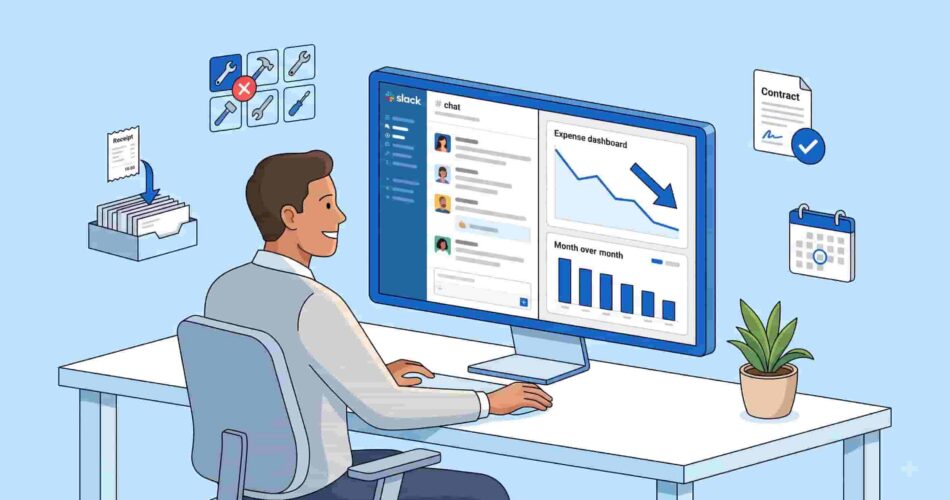
This sounds small but it isn’t. When expense approvals happen over chat with no record, you lose the audit trail, create compliance exposure, and make month-end reconciliation a manual archaeology project. A structured expense approval workflow — with one submission channel, automatic routing, and logged approvals — costs almost nothing to implement and saves hours every month.
12. Move expense submission inside Slack or Teams
The single biggest reason employees submit expenses late is friction. If filing an expense requires opening a separate portal, logging in, and navigating a dashboard, people will batch it until month-end — and you’ll spend the last week of every month chasing receipts. ExpenseTron keeps the entire expense workflow inside Slack or Teams — submission, approval, and accounting sync — so the path of least resistance is also the compliant one. When it’s easy to submit expenses in real time, your books stay cleaner and reimbursements happen faster.
13. Set a written expense policy before the next trip
Without a written policy, every unusual expense becomes a judgment call. Write down what’s reimbursable, what the per diem is for meals, what the hotel cap is by city, and what requires pre-approval. Our free travel expense policy template covers all the standard categories — copy it, fill in the brackets, and you have a policy by end of day.
14. Automate your accounting sync
If your finance team is manually re-entering approved expenses into QuickBooks or Xero at month-end, that’s a cost in time and a risk in errors. Automated accounting sync — where approved expenses flow directly into your books without anyone touching a spreadsheet — is standard in modern expense tools and eliminates one of the most common sources of month-end chaos.
15. Catch duplicate and non-compliant expenses early
Most expense fraud in small businesses isn’t malicious — it’s employees genuinely not knowing what the policy is. Automated policy checks that flag non-compliant expenses at submission catch issues before they’re approved, not after. This is one of the most underrated tips to reduce business expenses because the saving happens before money leaves the account.

Reduce operational waste
16. Audit your meeting culture
Meetings are an operating cost. Every hour your team spends in a meeting that could have been an async update is an hour not spent on actual work. Audit your recurring meetings quarterly — which ones have clear owners, agendas, and outcomes? Which ones are still running because nobody cancelled them?
17. Cut subscriptions your team hasn’t used in 30 days
Usage data is the cleanest way to make software decisions. Most tools — Google Workspace, Notion, Figma, Slack — offer admin dashboards that show who’s logged in and when. If a seat hasn’t been used in 30 days, deprovision it. For a 50-person team, this audit typically surfaces 5–10 unused seats per tool.
18. Switch to async-first communication for routine updates
Synchronous communication — calls, meetings, real-time Slack threads — is expensive because it requires everyone’s attention at the same time. Moving status updates, project reviews, and non-urgent decisions to async formats (Loom, voice messages, written briefs) reduces the meeting load and lets people work in their most productive time.
19. Review your insurance and financial products annually
Business insurance, payment processing fees, and banking products are easy to set and forget — and often easy to improve. Payment processing fees alone can often be reduced by switching providers or negotiating volume rates. Run a market check on these annually the same way you would on SaaS tools.
20. Measure cost per output, not cost per department
The most effective ways to reduce operating expenses come from looking at cost relative to output, not just in absolute terms. A marketing team spending $30k/month on ads that generate $300k in pipeline is efficient. The same spend generating $40k in pipeline is a problem — even if the absolute number hasn’t changed. Build unit economics into your monthly review.
Smart hiring and contractor strategies
21. Hire contractors before converting to full-time
For specialized work — design, development, content, data analysis — a contractor relationship lets you test the workload and the working style before committing to a full-time salary, benefits, and employer tax burden. Many of the best ways to cut costs in a small business involve being slower and more deliberate about full-time headcount.
22. Outsource non-core functions
Bookkeeping, payroll, IT support, legal review, and HR administration are all functions that most growth-stage companies can run more cheaply through specialists than by hiring in-house. SCORE’s 2024 survey found that 68% of small business owners who outsource report cost savings meeting or exceeding their expectations. The calculus changes as you scale, but for sub-100-person companies, outsourcing non-core functions is almost always cheaper.
23. Build a strong intern and apprenticeship pipeline
Structured internship programmes — connected to universities or vocational programmes — give you access to motivated contributors at a fraction of the cost of a full-time hire for defined project work. The key is structure: clear deliverables, real supervision, and genuine learning opportunities on both sides.
24. Use fractional executives for senior functions
A fractional CFO, CMO, or COO gives you senior strategic capacity without a full-time executive salary. For companies in the 2M–20M revenue range, a fractional CFO in particular often pays for itself — the financial discipline and cash flow visibility they bring typically saves more than their fee within the first quarter.
25. Review headcount against workload quarterly, not annually
Headcount is the largest cost line for most service and tech businesses, and it’s also the slowest to respond to workload changes. Build a quarterly review into your planning cycle: which roles are over capacity, which are under, and where has the work actually shifted? This isn’t about cutting people — it’s about making sure your team structure reflects how the business actually runs today, not how it ran 18 months ago.
Ways to cut business expenses: Frequently asked questions
What is cost cutting in business?
Cost cutting in business refers to the process of identifying and reducing unnecessary or inefficient expenditure without compromising the quality of your product, service, or team performance. Effective cost cutting in business goes beyond one-time reductions — it builds ongoing habits and systems that prevent waste from accumulating in the first place. The goal isn’t to spend as little as possible; it’s to spend intentionally on what actually drives results.
How do you reduce overhead expenses in a small business?
The most effective ways to cut overhead costs in a small business are: auditing office space utilisation and renegotiating or subletting unused areas; running a quarterly SaaS audit to identify and cancel redundant tools; assigning ownership to every recurring subscription; and switching from monthly to annual billing on tools you’re confident about. Overhead tends to grow by default — reducing it requires deliberate, scheduled review rather than one-off cuts.
What are some creative ways to cut costs in business without layoffs?
Some of the most effective creative ways to cut costs in business without reducing headcount include: subletting unused office space to generate income from a fixed cost; consolidating overlapping software tools to reduce seat count and vendor relationships; moving to fractional executive support for senior functions instead of full-time hires; implementing async-first communication to reduce meeting overhead; and automating expense and approval workflows to eliminate manual finance admin. Many companies find that process improvement and tool consolidation alone can meaningfully reduce operating costs without any impact on the team.
How do small businesses reduce expenses effectively?
The most practical tips to reduce business expenses for small companies focus on visibility first — you can’t cut what you can’t see. Start with a full audit of recurring costs: software, subscriptions, vendor contracts, and travel. Then assign ownership to each cost line, set renewal review dates, and build a quarterly check-in into your planning cycle. For expense management specifically, moving to a structured workflow with a tool like ExpenseTron eliminates one of the most common sources of invisible spend — untracked, unapproved, or duplicated expenses that slip through a manual process.
Most of the ways to cut business expenses on this list don’t require painful decisions. They require visibility, a bit of discipline, and systems that make the right behaviour the easy behaviour. Expense management is a good place to start — it’s one of the few areas where you can reduce cost and reduce admin at the same time, simply by moving the workflow to where your team already works.
If your expense process still runs on email, Slack DMs, and month-end spreadsheets, ExpenseTron handles submission, approval, and accounting sync entirely inside Slack or Teams. No new portal, no new login, no chasing receipts at month-end. For more on building an expense process that scales, browse the ExpenseTron blog.